

AI governance for healthcare
Every AI initiative.
One clear line of sight.
Know what to advance, why it was approved, and what happens after launch.
Vantage connects your AI portfolio, evidence, committee decisions, and follow-through in one governance workspace.
From the first request
to the next review.
Actual product view · Demonstration data
01 / PortfolioSee what deserves attention.
02 / DecisionsKeep evidence and accountability together.
03 / OversightStay involved after approval.
Inside the platform
One connected governance cycle.
Five views. From the first proposal to ongoing oversight.
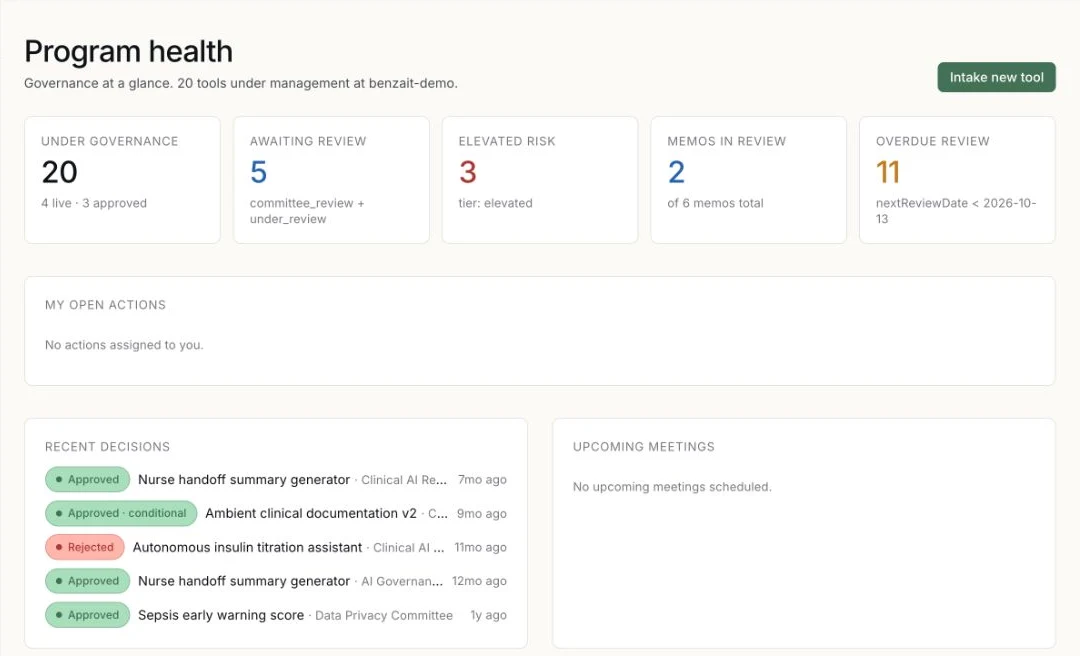
What needs our attention?
See the program. Find the next move.
Bring proposed and deployed AI into one register. See review queues, elevated risk, overdue reviews, and recent decisions from the program health view.
What this includes
- Named owners and lifecycle status
- Review queues and governance activity
- A clear route from intake to oversight
Each initiative carries its context into assessment and review.
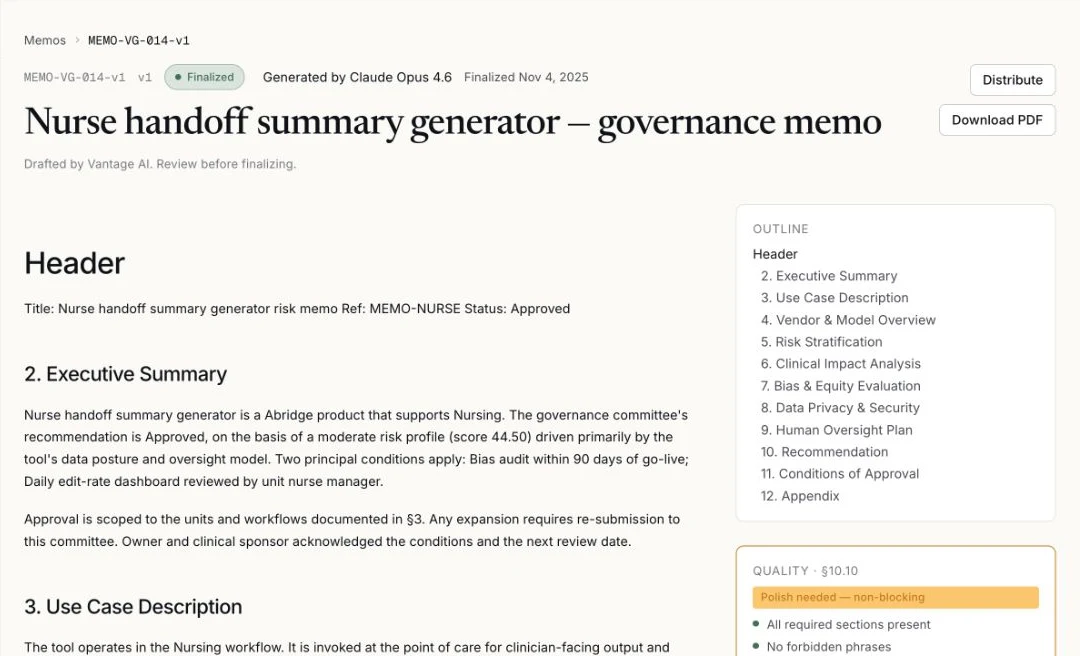
What is this decision based on?
Give the committee a decision it can examine.
Prepare AI-assisted governance memos from the proposal, assessment, and supporting documents. Review the evidence, refine the recommendation, and record the conditions before finalizing.
What this includes
- Intake, assessment, and documents in context
- Quality checks and visible AI contributions
- Human review, version history, and finalization
The reviewed memo travels with the initiative into the committee meeting.
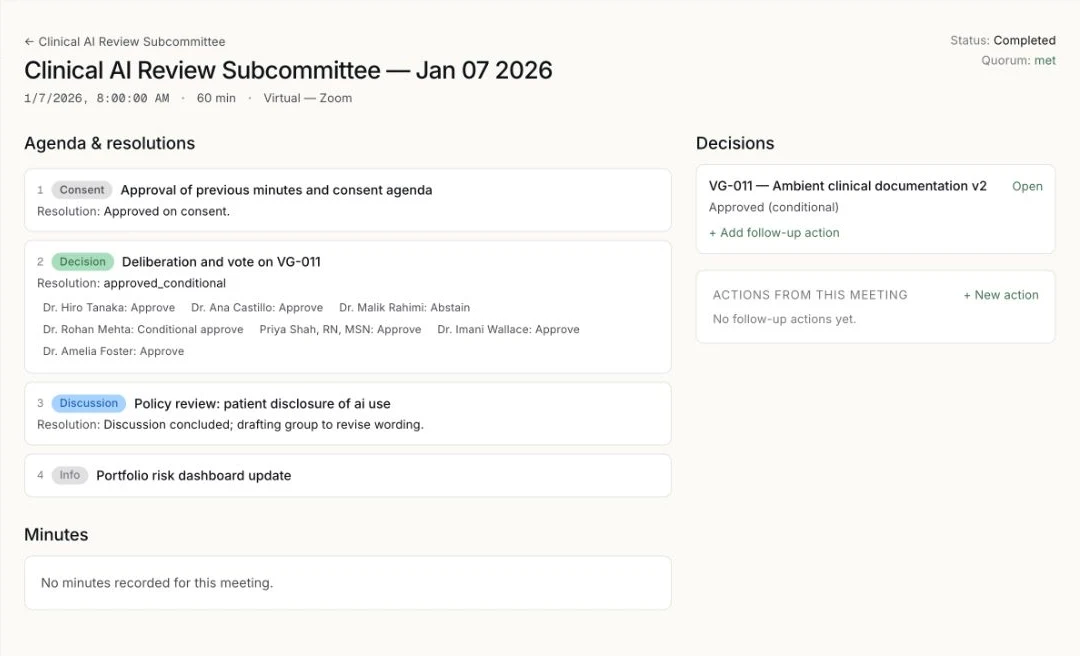
Who decided, and what must happen?
Turn a meeting into an accountable decision.
Bring the agenda, memo, minutes, and votes into the Committee Room. Record the outcome and approval conditions, then assign the follow-up work to an owner with a due date.
What this includes
- Committee agendas, votes, and minutes
- Recorded rationale and approval conditions
- Owned actions with due dates and status
Decisions update the initiative’s record; follow-up has a place to live.
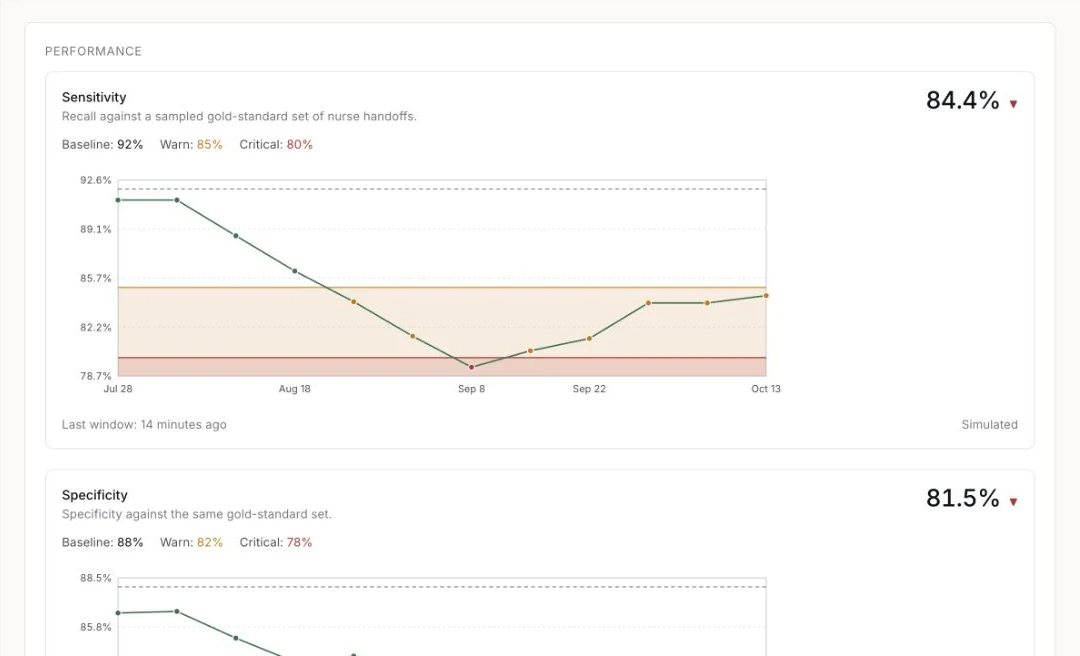
Is it performing as expected?
Approval begins the next responsibility.
Define outcome and performance measures, record observations, and compare them with baselines and thresholds. Review alerts, acknowledge issues, and record how they were resolved.
What this includes
- Tool-level performance and outcome measures
- Baselines with warning and critical thresholds
- Alert acknowledgement and resolution history
What happens after launch stays connected to the original initiative.
Can we explain the whole portfolio?
Walk into the boardroom with the whole story.
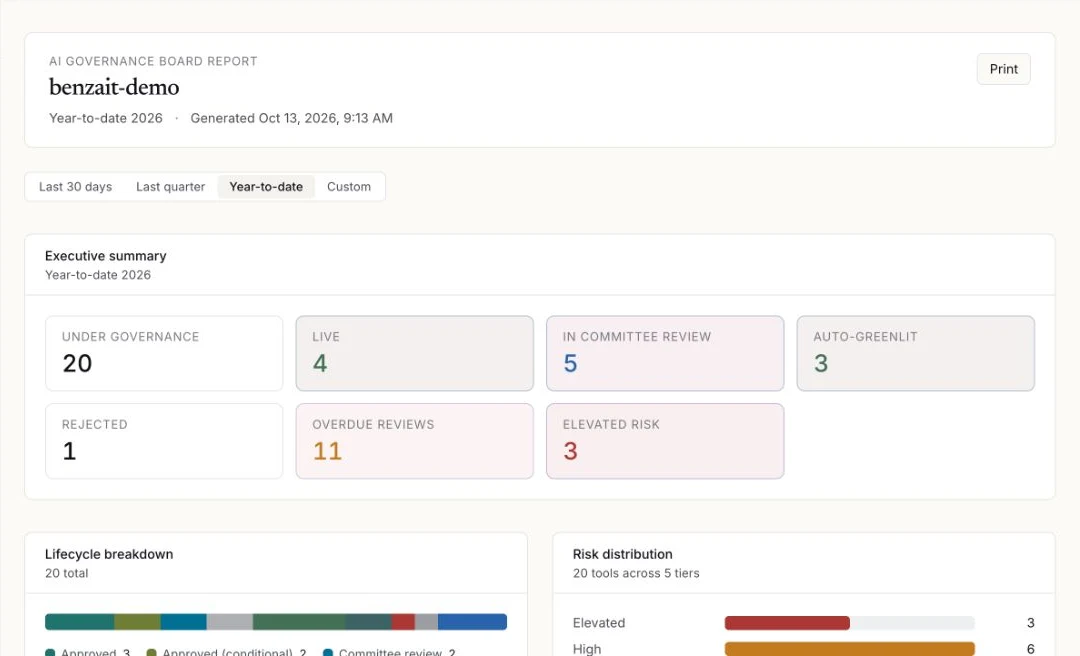
Bring portfolio posture, decisions, committee activity, policy coverage, and follow-through into a report for the period you need. Print a clear view from the records your program maintains.
What this includes
- Portfolio risk and lifecycle distribution
- Decisions, committee health, and open actions
- Period filters and a print-ready report
The report reflects the work already recorded across the program.
Judgment, built into the workflow
Same value.
Different responsibility.
A promising business case still needs the right review. Compare two proposals with identical scores and see how clinical use and patient information change the next step.
Explore your decision processStaff scheduling assistant
Greenlight for the next step
Nonclinical use, no PHI: the default greenlight criteria are met.
Next: Complete baseline risk screening before deployment can be considered.
How the review path is determined
Value: clinical impact, operational efficiency, revenue impact, strategic alignment, and user demand. Cost: implementation, ongoing operations, integration, change management, and compliance.
Default thresholds favor value of at least 60 and cost of 40 or less. Clinical use with protected health information routes to committee review by default. A greenlight does not authorize deployment. Authorized overrides require a reason and are recorded in the decision history.
Illustrative scores and workflow, not a live product interface.
The work behind the decision
Keep the context.
The portfolio is the starting point. Policies, vendor evidence, and a recorded history give every review the context it needs.
Policies in practice
Connect policies to frameworks, manage versions, and see gaps in coverage and acknowledgements.
Vendor evidence
Bring vendor documents, BAA records, and linked AI tools together for a review grounded in evidence.
Recorded history
Trace owners, decisions, conditions, and changes. Revisit the rationale without reconstructing it from inboxes.
One connected record
The reasoning survives the handoff.
- ProposalPurpose + owner
- ReviewEvidence + risk
- DecisionRationale + conditions
- Follow-throughActions + outcomes
Built by the people who do the work
Your governance program.
A much clearer view.
BENZAIT has designed, implemented, and run enterprise AI governance inside a health system. Vantage brings that operating perspective into the software.
Bring one AI initiative.
We’ll walk through the whole picture.
See how it enters the portfolio, reaches a decision, and stays visible after approval. We’ll discuss how Vantage would fit your governance process.
Explore our governance practice